
What Is the Average Google Rating by Industry?
The median Google rating ranges from 4.3 for hotels to a perfect 5.0 in eight of the 20 UK trades we track. The league table, why trades differ and how review count changes what a rating means.

The average Google rating by industry ranges from a median of 4.3 for hotels to a perfect 5.0 in eight of the 20 UK trades we track, including electricians, accountants, physiotherapists and driving schools. Across the Google ratings of 28,123 UK businesses, 15 of the 20 trades have a median of 4.8 or higher, so a rating that looks strong in one industry can be below average in the next.
This is the first article in our Reviews by trade series. It sets out the league table for all 20 trades, explains why one-to-one, appointment-based trades sit near 5.0 while hotels and restaurants sit lower, shows how review count changes what a rating means, and ends with how to use the figures for your own business.
Average Google rating by industry: the UK league table
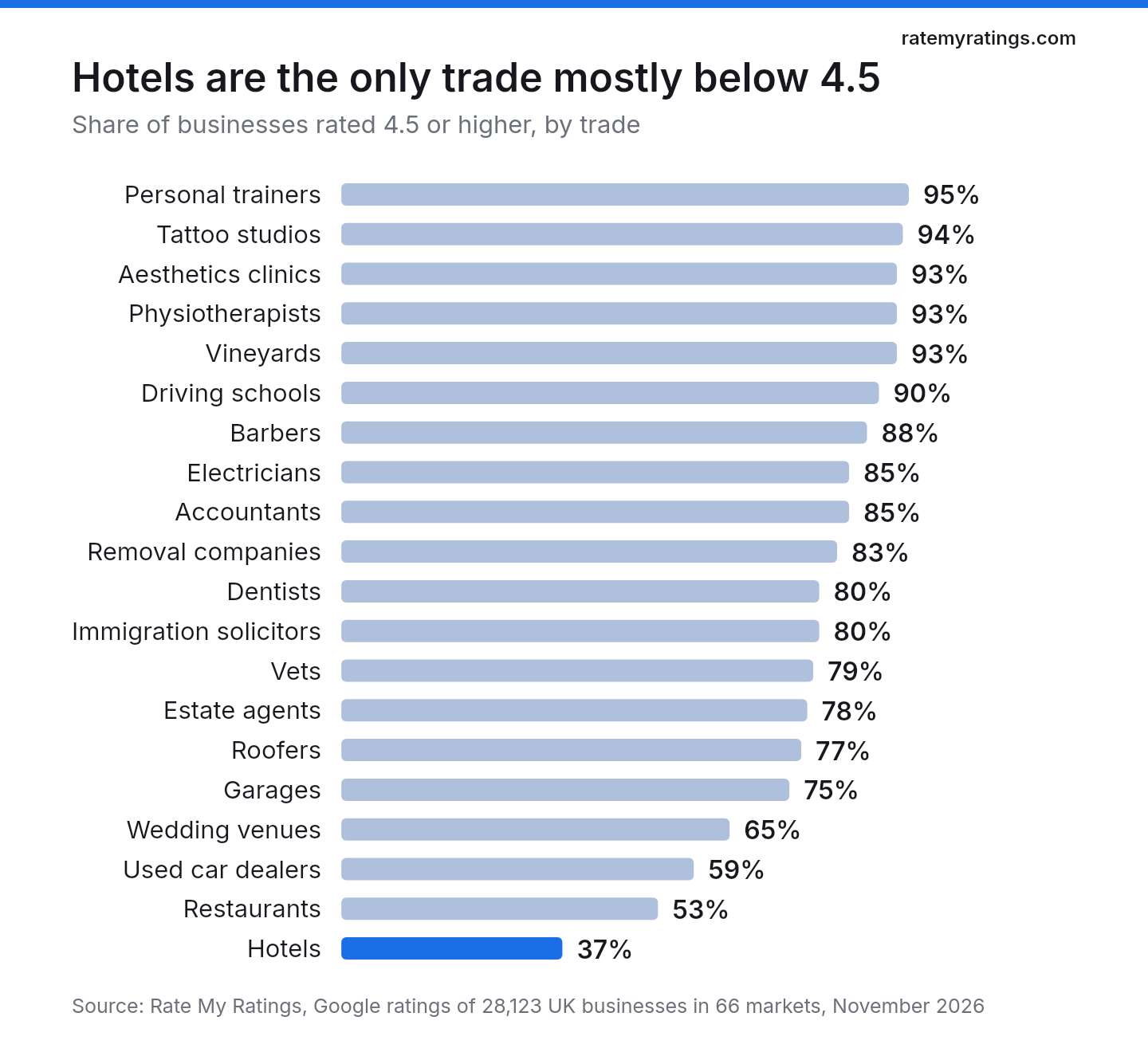
The table shows four figures for each trade: the median rating (the business in the middle, which is less distorted by a few outliers than a simple mean), the share with a perfect 5.0, the share rated 4.5 or higher, and the share below 3.5. It is sorted by the share rated 4.5 or higher.
| Trade | Median rating | Perfect 5.0 | Rated 4.5 or higher | Below 3.5 |
|---|---|---|---|---|
| Personal trainers | 5.0 | 80% | 95% | 0% |
| Tattoo studios | 4.9 | 44% | 94% | 1% |
| Aesthetics clinics | 5.0 | 65% | 93% | 2% |
| Physiotherapists | 5.0 | 67% | 93% | 1% |
| Vineyards | 4.9 | 39% | 93% | 2% |
| Driving schools | 5.0 | 62% | 90% | 4% |
| Barbers | 4.8 | 25% | 88% | 1% |
| Electricians | 5.0 | 68% | 85% | 6% |
| Accountants | 5.0 | 66% | 85% | 5% |
| Removal companies | 5.0 | 52% | 83% | 6% |
| Dentists | 4.8 | 29% | 80% | 5% |
| Immigration solicitors | 4.9 | 36% | 80% | 8% |
| Vets | 4.6 | 9% | 79% | 0% |
| Estate agents | 4.8 | 22% | 78% | 4% |
| Roofers | 5.0 | 54% | 77% | 9% |
| Garages | 4.8 | 25% | 75% | 5% |
| Wedding venues | 4.6 | 11% | 65% | 1% |
| Used car dealers | 4.6 | 17% | 59% | 8% |
| Restaurants | 4.5 | 7% | 53% | 5% |
| Hotels | 4.3 | 7% | 37% | 7% |
Three patterns stand out. Most trades are bunched near the top: in 19 of the 20, more than half of businesses are rated 4.5 or higher, and hotels are the only exception. Perfect scores are common: four in five personal trainers have one. And a high median can hide a long tail: roofers have a median of 5.0, yet 9% are below 3.5, the highest share of any trade.
The line below four stars matters because many customers draw it. In BrightLocal's 2026 Local Consumer Review Survey of US consumers, 68% said they would only use a business rated four stars or more. In our UK data, 20% of hotels, 15% of used car dealers and 13% of restaurants and roofers sit below 4.0, against 1% of personal trainers.
Why appointment-based trades sit near 5.0
The trades at the top have something in common: one customer, one professional, and a booking made on purpose. A personal trainer, a physiotherapist, an aesthetics practitioner or a driving instructor works with the same person over several sessions, and the person being reviewed is usually the person who did the work. Customers often arrive on a recommendation, and when the relationship does go wrong, it may simply end with a cancelled booking rather than a public review.
Review count plays a part too. These businesses collect fewer reviews than a restaurant or hotel, and a small number of reviews is far more likely to be all five stars. Electricians, accountants and roofers have a median of just seven reviews each, which is one reason about two-thirds of electricians and accountants have a perfect score.
Why hotels and restaurants sit lower
Hospitality is a different kind of business to review. The median hotel we track has 603 Google reviews and the median restaurant 361, so every bad night, slow service or noisy room eventually turns up. Each stay or meal has many touch points, many staff and a large element of taste, and a guest who pays a lot for one night judges everything against the price.
Wedding venues (median 4.6) and used car dealers (4.6) sit in between for similar reasons: high spending, a lot riding on the outcome and, for cars, problems that can appear after the sale.
Vets are unusually tightly bunched. Only 9% have a perfect score, yet almost none fall below 3.5. The typical practice has 217 reviews, a long record of ordinary good service that one difficult visit cannot overturn.
How review count changes the average
A rating is an average, and the fewer reviews behind it, the more likely it is to be perfect. In every one of the 20 trades, businesses with fewer than 10 reviews are more likely to have a 5.0 than those with 100 or more, usually by a wide margin.
| Trade | Perfect 5.0, fewer than 10 reviews | Perfect 5.0, 100 or more reviews | Median rating, 100 or more reviews |
|---|---|---|---|
| Electricians | 76% | 48% | 4.9 |
| Dentists | 70% | 13% | 4.8 |
| Driving schools | 69% | 57% | 5.0 |
| Vets | 67% | 2% | 4.6 |
| Garages | 57% | 5% | 4.7 |
| Restaurants | 50% | 1% | 4.5 |
| Hotels | 42% | 0% | 4.3 |
So a garage with 150 reviews and a 4.7 is exactly where an established garage usually sits, while a garage with six reviews and a 5.0 has simply not met its first difficult customer yet. Driving schools are the striking exception: 57% of schools with 100 or more reviews still have a perfect score, the highest share of any trade at that size.
What a perfect 5.0 means in your trade
A 5.0 means different things in different trades. For a personal trainer it is the norm; for a hotel or restaurant it is rare (7%), and among the hotels we track with 100 or more reviews there are none.
Customers seem to sense this. Northwestern University's Spiegel Research Center found that purchase likelihood typically peaks between 4.0 and 4.7 stars and falls as ratings approach 5.0, and only 10% of consumers in the BrightLocal survey insist on five stars. A 4.8 from 200 reviews usually persuades more than a 5.0 from eight, a point we cover in what makes people trust a business with low reviews and in why so many businesses have a perfect 5-star rating.
How to use the average Google rating by industry
The figures are a starting point, not a target. Use them in this order:
- Find your trade's row. Note the median and the share rated 4.5 or higher. If you are below your trade's median, you are below most of the businesses a customer compares you with.
- Compare with the businesses beside you. Search for your main service and town, and note the ratings and review counts of the first three or four results. Our guide to what a good Google rating is explains why that local comparison matters more than any national figure.
- Read your rating with your review count. If you have more than 100 reviews, compare yourself with the median for businesses of that size, which is lower than the overall median in half of the trades we track and never higher.
- Treat anything below 4.0 as urgent. Our guide on what a 3.5 star rating costs compared with 4.5 shows what that gap is worth.
- Chase volume and recency, not perfection. A steady flow of genuine reviews does more for ranking and trust than the last tenth of a star. Google says more reviews and positive ratings can help a business's local ranking, and our guide on how many Google reviews you need to rank sets out how to pick a number.
How we measured it
These figures use Google's own rating and review count for 28,123 UK businesses in 66 markets across 20 trades, collected in November 2026. Google's rating is the average of all the ratings published on Google for that business.
A market is one trade in one area, so the figures describe the areas we track, not the whole country. Restaurants come from five London areas, hotels from Bristol, and personal trainers, physiotherapists, tattoo studios and immigration solicitors from London. Our earlier articles used 46,800 businesses across the UK and Australia (October 2026), so a few trade figures differ slightly from those. Our methodology page explains how we collect and read reviews.
A guide for every trade
Over the next six weeks we publish a guide to each of the 20 trades, starting with Google reviews for electricians tomorrow and dentists and garages later this week. Each one has its trade's benchmark table, what customers praise and complain about, and how to ask for and reply to reviews within that trade's rules.
If you want the same view of your own town, a Rate My Ratings market report lists every business in your category and area with its Google rating, review count and share of positive reviews, plus the themes customers praise and complain about across the market.
The short version
- The average Google rating by industry runs from a median of 4.3 for hotels to 5.0 for eight trades, and 15 of 20 UK trades have a median of 4.8 or higher.
- One-to-one, appointment-based trades sit near 5.0; hotels, restaurants, wedding venues and used car dealers sit lower because volume and expectations are higher.
- Perfect scores mostly come from small numbers: 67% of vets with fewer than 10 reviews have a 5.0, against 2% of those with 100 or more.
- Compare yourself with your own trade and the businesses beside you in Maps, not with a single national figure.
Frequently asked questions
- What is the average Google rating for a UK business?
It depends on the trade. Across 28,123 UK businesses in 20 trades, the median Google rating ranges from 4.3 for hotels to a perfect 5.0 for eight trades, including electricians, accountants and physiotherapists. In 15 of the 20 trades the median is 4.8 or higher, so most local businesses are rated well above four stars.
- Which industries have the highest Google ratings?
In our UK data, personal trainers lead: 95% are rated 4.5 or higher and 80% have a perfect 5.0. Tattoo studios follow at 94%, then aesthetics clinics, physiotherapists and vineyards at 93%. These are mostly one-to-one, appointment-based businesses where the customer deals with the same person throughout.
- Why do hotels have lower Google ratings?
Hotels have far more reviews and far more things that can go wrong. The median hotel we track has 603 reviews, and each stay involves booking, check-in, the room, noise and breakfast. That is why the median hotel is rated 4.3, only 37% reach 4.5, and 20% are below 4.0.
- Is a 4.5 Google rating good?
For a hotel or restaurant, yes: 4.5 is at or above the median in both. In the other 18 trades we track, the median is 4.6 or higher, so a 4.5 is slightly below a typical competitor. Compare it with the businesses shown beside you in Google Maps, and with your review count.
- Does the number of reviews affect a Google rating?
Yes, strongly. Small numbers of reviews are far more likely to be all five stars. In our UK data, 67% of vets with fewer than 10 reviews have a perfect 5.0, against 2% of vets with 100 or more. For restaurants the figures are 50% and 1%. A rating on many reviews is lower but more believable.

Rate My RatingsNewsletter
What reviews say about local markets, in your inbox.
New articles and findings from the blog, as they're published.
Check your inbox.
If this address isn't subscribed yet, we've sent it a link to confirm. Nothing is sent until you click it.
That didn't go through. Check the email address and try again.
Hold on a moment, then subscribe again.